Understand the technology before you speculate on it. Twelve chapters explaining what blockchain actually solves, how Bitcoin and Ethereum work, what volatility changes for your risk management — and why this sector attracts so many scams.
0/12
01 The problem it solves
First things first, a simple question: what is a blockchain for? The answer comes down to one precise problem, decades old in computer science, that Bitcoin solved first. Once you understand that problem, everything else becomes obvious.
A digital file copies perfectly. That is what makes digital so convenient — and what stops it from being money. If your euro were a file, you could duplicate it and spend it twice. This problem has a name: double spending.
The classic solution is to hand the accounting over to a trusted third party. Your bank keeps the ledger of who owns what; when you pay, it debits your line and credits the other one. The system works perfectly, on one condition: trusting that third party, and accepting that it can freeze an account, refuse a transaction, or go bankrupt.
What Bitcoin proposed
In 2008, a paper published under the pseudonym Satoshi Nakamoto described a system in which the ledger belongs to no one: it is replicated across every participant, and a procedure lets them agree on its contents without any of them having to be trusted up front.
That is what blockchain really contributes: a shared ledger that strangers can agree on without a referee. Nothing more, nothing less. Any claim that reaches well beyond that deserves your suspicion.
What blockchain does not solve. It does not make anything free: fees exist and can be high. It does not make anything fast: Bitcoin handles about seven transactions per second, against several thousand for card networks. It guarantees no value: the price of an asset depends on supply and demand, not on the technology behind it. And it does not remove trust — it moves it to the code and to the platforms you will use.
When it is worth it, and when it is not
Blockchain adds something
No central authority that every party can accept
The participants do not trust each other
The history has to be verifiable by anyone
Censorship resistance has real value
A database is enough
A trusted entity already exists
Speed and cost matter more than decentralization
The data needs to be correctable
Confidentiality is required
Worth remembering
The problem solved is double spending: stopping a digital value from being spent twice, without a referee.
What it really contributes is a shared ledger that strangers agree on without a central authority.
Blockchain does not make anything free, fast or valuable. It moves trust, it does not remove it.
Put it into practice
Test the question every time
1The next time a project is presented to you as "on the blockchain", ask a single question: what trust problem between strangers does this solve?
2If the answer is vague, or if an ordinary database would do just as well, you have your answer.
3Note that this question alone rules out a large share of the projects you will be offered.
02 How it works
The mechanism is simpler than the vocabulary suggests. Three ideas are enough to grasp what matters: the block, the chain, and the hash. We will set them out without jargon.
The block and the chain
Transactions are grouped into batches called blocks. Each block contains the recent transactions, a timestamp, and — this is the essential point — a hash of the previous block.
That hash chains the blocks to one another. Changing an old transaction changes its block's hash, and therefore the hash of every block that follows. Falsifying the history would mean recomputing the whole chain from the point you changed, faster than the rest of the network extends it. That is what makes the record practically immutable.
The hash
A hash — the output of a hash function — turns data of any size into a string of fixed length. It has two properties that make the whole system work: the same data always produces the same hash, and the smallest change in the data produces a completely different hash.
That second property is what makes tampering detectable instantly: you simply recompute the hash and compare it.
Term you will see everywhere
What it actually means
Node
A computer that holds a full copy of the ledger and checks the rules
Block
A batch of transactions validated together
Hash
A short digital signature, unique to one specific piece of data
Consensus
The procedure by which the network agrees on the valid version
Public key
Your address: you can share it safely, like bank account details
Private key
Your signature: never share it, it gives access to the funds
The one thing you absolutely must take away from this chapter. Whoever holds the private key holds the funds. There is no customer service, no recovery procedure, no recourse. A lost private key means funds lost for good; a private key you hand over means funds stolen immediately. No legitimate party will ever ask you for it.
Each block's hash depends on the previous one's. That cascading dependency is the whole mechanism: it does not make tampering forbidden, it puts it arithmetically out of reach.
Worth remembering
Each block contains the hash of the one before it: falsifying the past would mean recomputing everything that follows.
A hash changes completely at the slightest change in the data. That is what makes tampering detectable.
Whoever holds the private key holds the funds. No recovery exists.
Put it into practice
Look at a real transaction
1Open a public block explorer — free ones exist for Bitcoin as well as for Ethereum.
2Open the latest block and look at it: its number, its timestamp, the number of transactions, the hash of the previous block.
3Follow one transaction and find the sending and receiving addresses.
4This ten-minute exercise makes the whole chapter concrete, and immunizes you against a lot of empty talk.
03 Agreeing without knowing each other
How do thousands of anonymous computers decide which version of the ledger is the right one? That is the heart of the problem, and two main answers coexist today. Their consequences are very different, environmental ones included.
Proof of work
This is the original mechanism, the one Bitcoin uses. To add a block, you have to solve a hard computational problem — slow to solve, but instant to check. Whoever finds the solution first proposes their block and receives a reward.
Security comes from the cost: falsifying the history would mean redoing all that work, faster than the entire network. That is economically prohibitive. The downside is direct: this work consumes electricity, on a scale comparable to that of a mid-sized country.
Proof of stake
Ethereum switched to this second mechanism in 2022. Here, the right to validate is not bought with electricity but by locking up tokens as collateral. A validator that cheats loses its collateral.
The change cut Ethereum's energy consumption by more than 99%. In exchange, it concentrates validation power among those who already hold a lot of tokens — a recurring and legitimate criticism.
Proof of work
Proof of stake
What you have to commit
computation, and therefore electricity
tokens locked up
Consumption
very high
low
Barrier to entry
expensive specialized hardware
capital in tokens
Main criticism
environmental impact
concentration of power
Examples
Bitcoin
Ethereum since 2022, Solana, Cardano
Neither one is better in absolute terms: they make different trade-offs between security, decentralization and cost. The debate is technical and legitimate — be wary of anyone who settles it in a single sentence, in either direction.
Two answers to the same problem: how to make sure a participant has something to lose by cheating. One commits electricity, the other capital.
Worth remembering
Proof of work: security comes from the cost in electricity. It is Bitcoin's mechanism.
Proof of stake: security comes from tokens locked up as collateral. Ethereum adopted it in 2022, cutting its consumption by more than 99%.
Neither one is better: they strike a different balance between security, decentralization and cost.
Put it into practice
Know what you are holding
1For every asset you hold or are considering, identify its consensus mechanism.
2Note who actually validates, and how many players it would take to control the network.
3This information is public. If it is hard to find, that is information in itself.
04 Bitcoin
The first, and by far the most studied. It deserves to be understood on its own terms, apart from everything that came after — because its rules are simple, public and unchanged since day one.
Bitcoin has been running since January 2009 on rules set from the start. Three of them are enough to understand its economics.
1A capped supply. There will never be more than 21 million bitcoins. That cap is written into the rules of the protocol and changing it would require the agreement of the overwhelming majority of the network.
2An issuance that shrinks. New bitcoins are created with every block, and that creation is halved roughly every four years. This is what is called the halving.
3A regulated pace. A block is added roughly every ten minutes. The difficulty of the computation adjusts automatically to hold that pace, whatever the number of participants.
What it is criticized for, and what it is credited with
The serious criticisms
Very high electricity consumption
Only about 7 transactions per second
Volatility incompatible with everyday use as money
Ownership heavily concentrated in a small number of addresses
What is established
No major network outage since 2009
Issuance rules that are public and verifiable by anyone
No authority can freeze an address
The most secure proof-of-work network
On price predictions. You will come across countless numerical projections, often backed by models that look rigorous. None has any demonstrated predictive value, and several of the most famous have been proved wrong by events. Bitcoin has fallen more than 70% from its high on several occasions. Any exposure has to be sized on the assumption that it will happen again.
Worth remembering
Three fixed rules: 21 million units at most, issuance halved every four years, one block every ten minutes.
The network has run without a major outage since 2009, on rules anyone can verify.
Falls of more than 70% from a high have happened several times. Size your exposure assuming they will.
Put it into practice
Look at the full history
1Open a Bitcoin chart covering its entire history, on a logarithmic scale.
2Find the four big declines and measure how far each one fell in percentage terms from the previous high.
3For each one, measure how long it took to get back to that high.
4Ask yourself honestly whether you would have held your position through those periods. The answer sets a sensible size for your exposure.
05 Ethereum and contracts
Bitcoin transfers value. Ethereum added a different idea: running code on the shared ledger. That is what made possible the whole ecosystem that followed — for better and for worse.
A smart contract is a program placed on the blockchain that runs automatically when its conditions are met. "If A sends 1 ETH, then transfer such-and-such token to A" — with no intermediary, no way to refuse, and no way to modify it once deployed.
That immutability is both the guarantee and the main danger. A contract with a flaw cannot be fixed: it can only be abandoned, after the funds have been drained.
What it made possible
Decentralized finance — lending, borrowing and trading without an intermediary.
Tokens — anyone can create an asset in a few minutes. That is also what makes scams so easy.
Non-fungible tokens — a unique certificate of ownership recorded on the chain.
Autonomous organizations — governance rules written into the code.
The risk specific to contracts. Losses caused by flaws in smart contracts run into billions of dollars in total since 2016. An audited contract is not a safe contract: several audited protocols have been drained. If you deposit funds in a protocol, treat it as accepting a technical risk on top of the market risk — and size accordingly.
Fees
Every operation on Ethereum costs a fee, called gas, paid in ETH. The amount varies with network congestion and can go from a few cents to several tens of euros for the same operation.
That variability has an important practical consequence for a small wallet: a €50 transaction can cost €20 in fees on a busy day. Always check the cost before you confirm, and know that so-called second-layer networks exist precisely to bring that cost down.
Worth remembering
A smart contract runs automatically and can no longer be modified once deployed.
That immutability is both the guarantee and the danger: a flaw does not get fixed, it gets drained.
Fees vary a great deal. On a small amount, they can account for a major share of the operation.
Put it into practice
Measure the real cost before you act
1Before any operation, check the fee level on the network involved — public trackers exist.
2Work out the fee as a percentage of the amount transferred. Above 2%, wait or switch networks.
3If you are considering a decentralized finance protocol, look up its incident history before depositing anything.
06 Finding your way around the ecosystem
Tens of thousands of assets exist. Almost none of them concern you. This chapter gives you the filter, to tell the main categories apart and know what each one actually involves.
Category
What it is
What you need to know
Native currency
A blockchain's own asset (BTC, ETH)
Used to pay the network's fees; the most liquid
Token
An asset created on an existing blockchain
Creating a token takes a few minutes and proves nothing
Stablecoin
A token pegged to a currency, often the dollar
Its quality depends entirely on the reserves backing it
Governance token
Gives a right to vote on a protocol
The value of the vote depends on what it actually decides
Non-fungible token
A unique certificate of ownership
Very illiquid market; resale is never guaranteed
Meme token
No claimed use
Pure speculation, to be treated as such
Stablecoins deserve particular attention
They serve as the unit of account across the whole ecosystem, and many people treat them as equivalent to dollars. They are not. A stablecoin is worth whatever the reserves supposed to back it are worth, and the quality of those reserves varies considerably from one issuer to the next.
The May 2022 episode, in which a so-called algorithmic stablecoin lost nearly all of its value in a few days, showed that the word "stable" guarantees nothing. Stablecoins backed by audited reserves published on a regular basis carry a far smaller risk — but not a zero one.
The four-question filter. Before you take an interest in an asset: who created it, and is that public? What is it concretely for, in one understandable sentence? How many units exist, and who holds them? Can it be sold easily, meaning what is its real trading volume? If any one of these questions has no clear answer, walk away.
Worth remembering
Creating a token takes a few minutes: its existence proves strictly nothing.
A stablecoin is worth what its reserves are worth. The word "stable" guarantees nothing.
Four filtering questions: who created it, what it is for, how many units exist, whether it can be sold.
Put it into practice
Apply the filter
1Take three assets you have heard about recently.
2Answer the four questions for each one, finding the sources yourself.
3Note how long it took you and how many questions went unanswered.
4This exercise is usually enough to cut a list of ten assets down to one or two.
07 Exchanges and wallets
Where your assets actually sit determines what can happen to them. This is the most practical chapter in the module, and the one that prevents the most permanent losses.
The fundamental distinction
On an exchange, your assets are held by the company. You have a claim on it, not the keys. It is convenient — buying, selling, password recovery — and it exposes you entirely to that company's soundness and honesty.
In a personal wallet, you hold the keys. No one can freeze your funds or go bankrupt with them. In exchange, no recovery is possible: a lost recovery phrase means funds lost for good.
On an exchange
Simple, with customer support
Access can be recovered
Exposed to the exchange going bankrupt
Exposed to accounts being frozen by regulators
In a personal wallet
You alone control the funds
Unaffected by a third party going bankrupt
No recovery if you lose access
The entire responsibility rests on you
The lesson of November 2022. The collapse of one of the largest exchanges showed that deposited funds could become inaccessible overnight, including at a well-regarded and widely covered firm. The phrase that circulates in the sector — "not your keys, not your coins" — is not an ideological slogan: it is an exact description of the legal situation.
The practical rule
1Leave on an exchange only what you intend to trade in the short term.
2Move the rest to a wallet whose keys you hold.
3For significant amounts, use a hardware wallet — a dedicated device that keeps the key offline.
4Write the recovery phrase down on paper, never as a photo or in a file. Keep it in two separate places.
5Test a recovery with a small amount before moving the bulk of your holdings across.
This last step is the one everybody skips, and it is the most important. Finding out that your recovery phrase was written down wrong at the moment you need it leaves you with no way out.
The distinction comes down to one sentence: on an exchange you hold a claim; in a personal wallet you hold the funds. The bankruptcies of 2022 taught a lot of people that difference, too late.
Worth remembering
On an exchange, you hold a claim against a company, not the keys to your assets.
In a personal wallet, you control everything — including the responsibility of losing nothing.
Test the recovery with a small amount before moving the bulk across. Nobody does it, and it is the decisive step.
Put it into practice
Put your holdings out of harm's way
1Take stock of what you hold and exactly where it sits.
2Work out how much is sitting on an exchange with no reason to be there.
3If that share is significant, open a personal wallet and move a small amount across first.
4Test a restore from your recovery phrase before moving the rest.
08 What volatility changes
Everything you learned in the Risk and Strategies modules applies here. Only one thing changes, but it changes a lot: the size of the moves. This chapter puts that difference into concrete numbers.
A 5% daily move is exceptional on EUR/USD, common on Bitcoin, and unremarkable on a small-cap asset. That does not make crypto more dangerous in itself — it simply means sizing differently.
The mechanism is straightforward: at constant risk, higher volatility forces a wider stop, and therefore a smaller position. That is exactly what the position size calculation from the Risk module does, unchanged.
Market
Typical daily move
Trading hours
Effect on position size
Major currency pairs
0.3 to 0.8%
24/5
baseline
Stock indexes
0.5 to 1.5%
market sessions
close to baseline
Bitcoin
2 to 5%
24/7
about 4 times smaller
Large altcoins
4 to 8%
24/7
about 8 times smaller
Small caps
10% and above
24/7
to be avoided as a sized position
Orders of magnitude under normal conditions. These ranges double or triple during episodes of stress.
Three structural differences
The market never closes. There is no pause to digest news, and above all: the most violent moves often happen at the weekend, when liquidity is thinnest and you are asleep. A position left open without a stop on Friday evening is uncontrolled exposure.
Liquidity is very uneven. Bitcoin and Ethereum trade easily. A lower-ranked asset can see its price move several percent on a single mid-sized order. The price on screen is not the price you will get out at.
The leverage on offer is extravagant. Some exchanges offer 100:1 or more on assets that move 5% a day. We saw in the Safety module what that implies: at that level, liquidation is a matter of hours, not of scenarios.
For strictly identical risk, the amount committed varies by a factor of thirty-two. Crypto therefore calls for no new rule: it calls for applying the one from the Risk module seriously.
Worked example
The same 1% rule, from Forex to Bitcoin
A trader applies their risk rule strictly across three markets. The amount risked never changes; it is the position size that adapts to the volatility.
Inputs
Capital
€10,000
Risk per position
1% → €100
EUR/USD — stop
25 pips (≈ 0.23%)
Bitcoin — stop
3% of price
Altcoin — stop
8% of price
Bitcoin price used
$60,000
Calculation
EUR/USD — 100 ÷ (25 × 10) = 0.40 lot, that is €40,000 of notional
Bitcoin — distance: 60,000 × 3% = $1,800
Bitcoin — quantity: 100 ÷ 1,800 = 0.0555 BTC, that is €3,333 of notional
Altcoin — distance: 8% of price
Altcoin — notional: 100 ÷ 0.08 = €1,250
Ratio between the notionals: 40,000 / 3,333 / 1,250
Result€40,000 · €3,333 · €1,250 — for an identical risk of €100
The notional committed varies by a factor of thirty-two between Forex and the altcoin, while the risk stays rigorously the same. This is the demonstration that crypto requires no new rule: it requires applying the existing rule, which many people fail to do because the position then looks "too small" to them. It is not too small: it is correct.
Worth remembering
Crypto requires no new rule: it requires applying the existing position size calculation, without exception.
The market never closes, and violent moves often happen at the weekend. No position without a stop.
The price on screen is not the exit price on an illiquid asset.
Put it into practice
Recalculate your positions
1Take your current crypto positions, or the ones you are considering.
2For each one, work out the loss in euros if the stop were hit, then as a percentage of your capital.
3If the result is over 1%, reduce the size — not the stop.
4Check that every position left open on Friday evening does carry an active stop.
09 Cycles and the halving
The crypto market shows a marked alternation of euphoria and collapse, which many people tie to the halving calendar. Let us look at what the data actually shows, and what belongs to storytelling.
The halving cuts the creation of new bitcoins in half, roughly every four years. Mechanically, new supply falls. The common idea is that, with demand unchanged, this pushes the price up.
Historically, marked rises did indeed follow the halvings of 2012, 2016 and 2020. That observation deserves three serious caveats, however.
Three observations do not make a pattern. Statistically, nothing can be concluded from a sample of three.
Correlation is not causation. Those periods also coincide with global liquidity cycles and waves of adoption. Isolating the effect of the halving is impossible.
Anticipation cancels the effect. The halving is known years in advance. If it mechanically produced a rise, the market would already have built it into the price.
The four phases, with no claim to predict them
What is descriptively useful, on the other hand, is the alternation of the market's psychological states. It does not tell you when, but it helps you recognize where you are.
Phase
What you see
What most people do
Accumulation
Low prices, general indifference, media silence
Stops looking, has given up
Rise
Steady progress, attention returns
Hesitates, waits for a pullback that never comes
Euphoria
Acceleration, heavy media coverage
Buys, often with leverage
Collapse
Rapid fall, cascading liquidations
Holds on hoping, then sells at the bottom
A retrospective description. None of these phases can be identified with certainty while it is happening — which is precisely what makes the cycle so effective.
The most reliable warning signal. When people around you who take no interest in the markets start talking to you about crypto unprompted, you are probably in the euphoria phase. It is not a precise indicator and it says nothing about timing — but it has preceded every one of the major turns. At that point, the question to ask is not what to buy, but how much of your gains you have already secured.
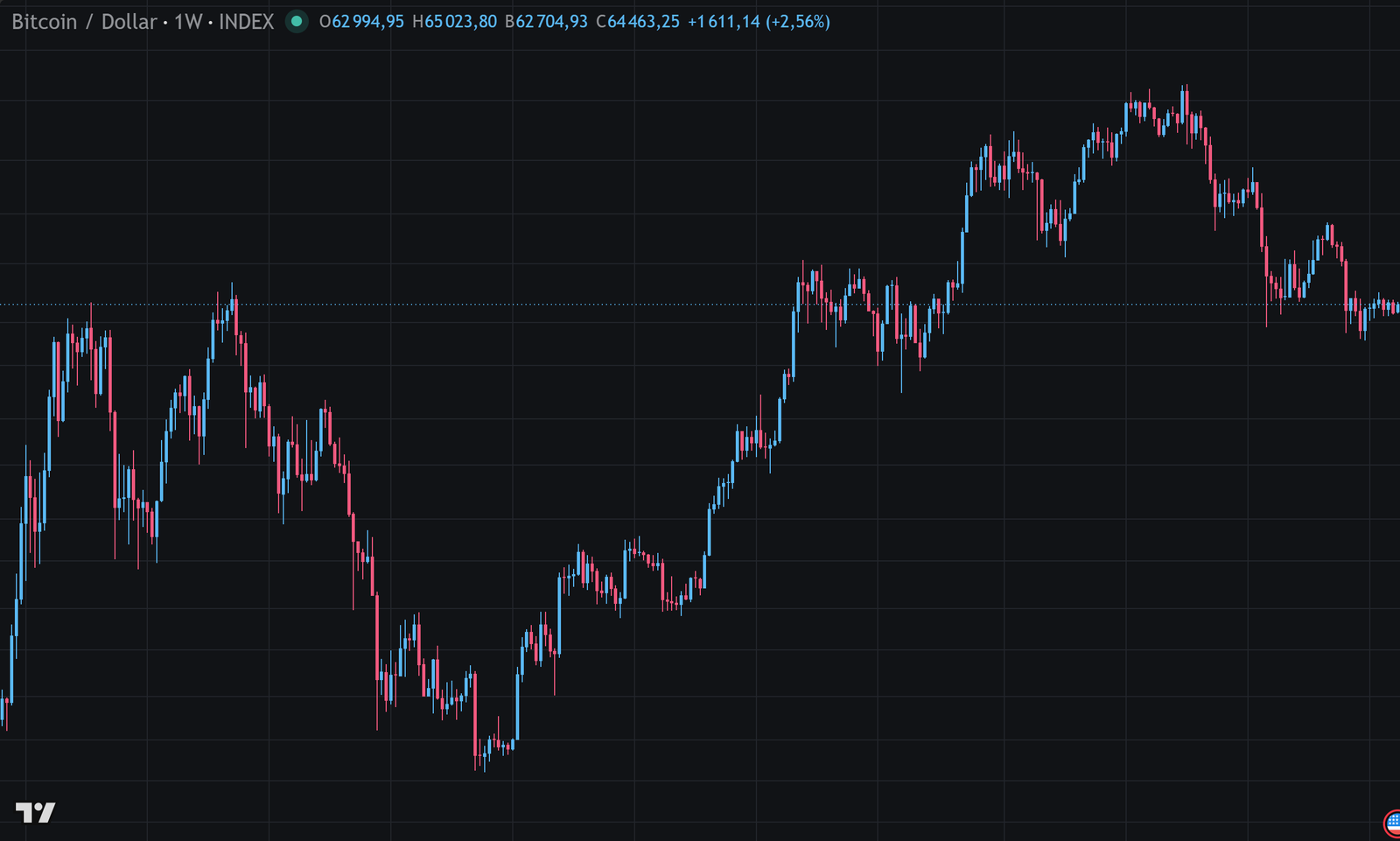
Six years on a logarithmic scale. Each marker sits at its date: the November 2021 high, the November 2022 low at −78%, the October 2025 high, the June 2026 low at −54%. These declines are not accidents of the cycle, they are part of it — and none of them was announced in advance.Bitcoin against the dollar, weekly — chart by TradingView. Past data, with no predictive value.
Worth remembering
Three halvings followed by rises do not make a statistical pattern.
An event known years in advance is already built into the price.
The four phases are useful for placing yourself, never for predicting. None can be identified while it is happening.
Put it into practice
Decide now, not in the euphoria
1Write down in advance at what level of gain you will take part of your position off, and what proportion.
2Write down in the same way at what level of loss you exit entirely.
3Both decisions are made now, calmly, never during the move.
4Place the corresponding orders if your exchange allows it. A decision made concrete holds; an intention does not.
10 Reading the chain
What sets this market apart is that every transaction is public. That opens up a kind of analysis that exists nowhere else — and that is as over-interpreted as it is underused.
What is called on-chain analysis consists of studying the ledger data directly: the number of active addresses, volumes transferred, movements to and from exchanges, the age of the units held. This data can be verified by anyone, which sets it radically apart from traditional market data.
Indicator
What it measures
Limitation
Active addresses
The number of addresses that have transacted
One person can hold thousands of them
Flows to exchanges
Units moved to a trading venue
Does not say whether they will be sold
Outflows
Units moved into a personal wallet
May reflect a simple reorganization
Age of the units
How long since they last moved
One of the most robust indicators
Exchange reserves
What the exchanges hold
Depends on how reliable the address labeling is
The two traps
Labeling. Assigning an address to an exchange or to a category of player is a matter of heuristics, not certainty. Data providers use different methods and sometimes reach opposite conclusions about the same period.
Retrospective storytelling. There are enough on-chain indicators that one can always be found that "explained" the move after the fact. It is the same failing as with chart patterns, with an added veneer of rigor.
The reasonable use for a private investor. On-chain analysis gives background context, not entry points. It sheds light on questions such as "are long-term holders accumulating or distributing?", which play out over months. It will never tell you when to buy. If someone is selling you entry signals based on on-chain data, you know what to make of it.
Worth remembering
Every transaction is public: that is a genuine peculiarity of this market.
Address labeling is a matter of heuristics. Two providers can reach opposite conclusions.
On-chain analysis gives context over months, never an entry point.
Put it into practice
Get familiar with a single metric
1Pick a simple on-chain indicator, for example the share of units that have not moved for more than a year.
2Track it every week for two months, writing down its value.
3Compare how it moves with how the price moves, without looking for causation.
4What you will mainly see is that it moves slowly — which is exactly the point to take away.
11 The scams specific to the sector
The Safety module covered the classic scams. These ones are specific to crypto, exploit its technical mechanics, and are for the most part irreversible — because a confirmed transaction cannot be taken back.
The six most widespread forms
1The liquidity pull. The creators of a token withdraw, all at once, the funds that made it tradable. The price collapses to zero and nobody can sell any more.
2The token you cannot sell back. The contract allows buying but blocks selling for everyone except its creators. The price rises, nobody can get out.
3The pump before the dump. An organized group buys an illiquid asset, promotes it heavily, then sells into the buyers it has drawn in.
4The fake technical support. An account imitating an official service contacts you after a public post and asks for your recovery phrase in order to "help you".
5The unlimited approval. A site gets you to sign an authorization that lets a contract empty your wallet, now or in six months.
6The fake relationship. A patient contact, often struck up on a dating or messaging app, steers you gradually toward an investment platform controlled by the scammer.
Irreversibility changes everything. With a bank transfer, there is sometimes a way to get the money back. On a blockchain, a confirmed transaction is final: no operator, no court, no procedure can reverse it. That is what makes these scams so profitable, and it is why the checking has to happen before, never after.
The rules that protect you
No legitimate party ever asks for your recovery phrase. No exception, no context, no emergency.
A guaranteed high fixed return does not exist. No legitimate investment promises a certain percentage.
Revoke the authorizations you have granted, regularly. Free tools let you list and cancel the approvals given to contracts.
Use a separate wallet for exploring. Never connect the wallet that holds your assets to a site you are just discovering.
Be wary of urgency. Any time pressure — a limited sale, a place to grab — is a signal in itself.
Worth remembering
A confirmed transaction on a blockchain is final: there is no recourse.
No legitimate party ever asks for your recovery phrase, on any pretext.
Use a separate wallet for exploring, and revoke the authorizations you have granted, regularly.
Put it into practice
Clean house today
1List the authorizations your wallet has granted to contracts, using a public revocation tool.
2Revoke everything you no longer use, and unlimited-amount approvals in particular.
3Create a secondary wallet, with no holdings, reserved for exploring new sites.
4Check that your recovery phrase exists nowhere in digital form: no photo, no file, no message.
12 Your crypto rules
This chapter gathers the module into rules you can apply. They do not replace the ones from the Risk and Safety modules — they are added to them, because this market carries risks the others do not.
Before buying anything at all
1I can explain in one sentence what this asset is for, without using jargon.
2I know who created it, and that information is public and verifiable.
3I have checked its real trading volume: I will be able to sell.
4The amount committed respects my risk rule, calculated with a stop suited to the volatility.
5I can lose this amount in full without it changing anything in my life.
On custody
1I leave on an exchange only what I trade in the short term.
2My recovery phrase is on paper, in two separate places, never in digital form.
3I have tested a restore with a small amount before moving the bulk across.
4I use a separate wallet to explore sites I do not know.
On behavior
1I use no leverage on this market. The volatility is more than enough.
2No position is left open at the weekend without an active stop.
3I have written down in advance at what level I secure part of my gains.
4I answer no approach, on any network, about an investment.
This module in one sentence. Blockchain solves a real and precise problem; the industry built around it concentrates an unusual quantity of scams. Both statements are true at the same time, and being able to hold them together is exactly what will protect you — from wholesale rejection as much as from blind enthusiasm.
Worth remembering
Five checks before any purchase, the first being: being able to explain the asset in one sentence without jargon.
Leave on an exchange only what you trade in the short term, and test your recovery.
No leverage on this market: the volatility already provides all the range you need.
Put it into practice
Move on to the next module
1Apply the five checks to what you already hold. Write down what fails the test.
2Put your holdings out of harm's way, following the custody rules in chapter 7.
3If you have not already done so, read the Safety module in full: half of what threatens a crypto wallet is covered there.
4Then move on to the assessment test, which covers the whole course.